Action urged to combat global obesity 'pandemic'

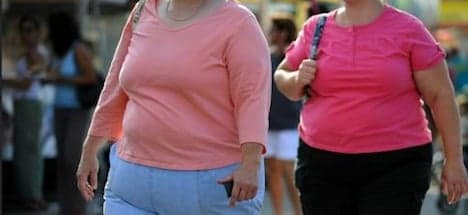
Obesity has become a global pandemic that could leave more than half of all adults worldwide overweight within two decades, say experts in Davos who are calling for urgent action beyond just blaming people for lacking willpower.
Speaking at the World Economic Forum, health, nutrition and fitness experts said the world's increasingly deadly obesity crisis needs to be tackled with the same determination policy-makers once took to fighting smoking.
With our food more and more unhealthy and our lives increasingly sedentary, answers are needed to address a crisis that is driving up diabetes, boosting heart disease and already killing 2.8 million adults per year, they said.
The current figure of 1.4 billion adults already overweight globally is set to soar, Linda Fried, dean of the Mailman School of Public Health at Columbia University, told a panel on obesity at the annual gathering of the global elite, which ended on the weekend.
"In another 20 years, if things continue to increase the way they are, it may well be that 50-60 percent of the world's adult population will be overweight," Fried said.
"If this were an infectious disease we might call it a pandemic," she said.
"It's not regional, it's global, it's increasing rapidly, it's continuing to escalate — those are the basic definitions of a pandemic," she said.
The first step to resolving the crisis, the experts said, is overcoming the instinctive reaction many have to obesity — blaming the obese themselves instead of the conditions around them.
"In 30 years, the percent of the world's population that is overweight or obese has doubled," Fried said.
"There's no evidence that there has been a collective global loss of willpower."
The blame rests instead with the easy availability — and relative cheapness — of higher-calorie foods and increasing urbanization that has led to less active lifestyles, the experts said.
'Inactivity crisis'
Lisa MacCallum Carter, Nike's Vice-President for Access to Sport, said obesity was linked to an "inactivity crisis" as a result of urbanisation.
She said significant amounts of daily exercise from incidental movement had been lost, with for example people now sending emails instead of walking across the office to talk to a colleague.
She cited research showing that Americans are now 32 percent less active than in 1967, and if current trends continue they will be 50 percent less active by 2030.
In just half a generation, she said, the Chinese had also become 45 percent less active.
At the same time, the foods we eat are becoming less healthy, with fattier, higher-salt and artificial products easier to produce and distribute, the experts said.
"The ways we see markets working are accelerating these trends very rapidly," said Marc Van Ameringen, executive director of the Global Alliance for Improved Nutrition (GAIN).
Some governments, as in the United States, are encouraging this by subsidizing industrial food production, as with corn syrup, which is widely used in prepared foods as a sweetener and thickener, he said.
"Look at the money that goes into producing corn and corn-syrup products, compared to the subsidies that go into producing fruit and vegetables," he said.
Fried said some policy-makers have taken encouraging steps to fight obesity, like Mayor Michael Bloomberg of her native New York.
His crusade against junk food has seen the city ban the sale of "supersize" soft drinks and require fast-food restaurants to label menus with calorie information.
The experts said steps like widespread calorie-labelling laws, limits on portion sizes and increased taxes on unhealthy food would make a difference.
Too much blame on food companies?
Paul Bulcke, the CEO of Swiss food giant Nestlé, said too much blame was being laid on food companies.
"It is a very complex problem," he said.
"Yes, we are attacked, but that comes a bit from a society that wants to blame."
He said Nestlé supported "meaningful labelling" of its products and that governments had an obligation to increase nutritional education.
MacCallum Carter of Nike said more had to be done to restore physical activity to daily life.
"On the nutrition side this problem is being looked at in a very sophisticated way," she said.
"But we're certainly not resolving the physical activity crisis."
The experts said children needed to be involved in sport and individuals, companies and governments needed to work together to boost physical activity, for example by redesigning urban spaces to require more walking.
"We have a health emergency, it is global and it is of huge dimensions . . . we can only solve it together," Fried said.
Comments
See Also
Speaking at the World Economic Forum, health, nutrition and fitness experts said the world's increasingly deadly obesity crisis needs to be tackled with the same determination policy-makers once took to fighting smoking.
With our food more and more unhealthy and our lives increasingly sedentary, answers are needed to address a crisis that is driving up diabetes, boosting heart disease and already killing 2.8 million adults per year, they said.
The current figure of 1.4 billion adults already overweight globally is set to soar, Linda Fried, dean of the Mailman School of Public Health at Columbia University, told a panel on obesity at the annual gathering of the global elite, which ended on the weekend.
"In another 20 years, if things continue to increase the way they are, it may well be that 50-60 percent of the world's adult population will be overweight," Fried said.
"If this were an infectious disease we might call it a pandemic," she said.
"It's not regional, it's global, it's increasing rapidly, it's continuing to escalate — those are the basic definitions of a pandemic," she said.
The first step to resolving the crisis, the experts said, is overcoming the instinctive reaction many have to obesity — blaming the obese themselves instead of the conditions around them.
"In 30 years, the percent of the world's population that is overweight or obese has doubled," Fried said.
"There's no evidence that there has been a collective global loss of willpower."
The blame rests instead with the easy availability — and relative cheapness — of higher-calorie foods and increasing urbanization that has led to less active lifestyles, the experts said.
'Inactivity crisis'
Lisa MacCallum Carter, Nike's Vice-President for Access to Sport, said obesity was linked to an "inactivity crisis" as a result of urbanisation.
She said significant amounts of daily exercise from incidental movement had been lost, with for example people now sending emails instead of walking across the office to talk to a colleague.
She cited research showing that Americans are now 32 percent less active than in 1967, and if current trends continue they will be 50 percent less active by 2030.
In just half a generation, she said, the Chinese had also become 45 percent less active.
At the same time, the foods we eat are becoming less healthy, with fattier, higher-salt and artificial products easier to produce and distribute, the experts said.
"The ways we see markets working are accelerating these trends very rapidly," said Marc Van Ameringen, executive director of the Global Alliance for Improved Nutrition (GAIN).
Some governments, as in the United States, are encouraging this by subsidizing industrial food production, as with corn syrup, which is widely used in prepared foods as a sweetener and thickener, he said.
"Look at the money that goes into producing corn and corn-syrup products, compared to the subsidies that go into producing fruit and vegetables," he said.
Fried said some policy-makers have taken encouraging steps to fight obesity, like Mayor Michael Bloomberg of her native New York.
His crusade against junk food has seen the city ban the sale of "supersize" soft drinks and require fast-food restaurants to label menus with calorie information.
The experts said steps like widespread calorie-labelling laws, limits on portion sizes and increased taxes on unhealthy food would make a difference.
Too much blame on food companies?
Paul Bulcke, the CEO of Swiss food giant Nestlé, said too much blame was being laid on food companies.
"It is a very complex problem," he said.
"Yes, we are attacked, but that comes a bit from a society that wants to blame."
He said Nestlé supported "meaningful labelling" of its products and that governments had an obligation to increase nutritional education.
MacCallum Carter of Nike said more had to be done to restore physical activity to daily life.
"On the nutrition side this problem is being looked at in a very sophisticated way," she said.
"But we're certainly not resolving the physical activity crisis."
The experts said children needed to be involved in sport and individuals, companies and governments needed to work together to boost physical activity, for example by redesigning urban spaces to require more walking.
"We have a health emergency, it is global and it is of huge dimensions . . . we can only solve it together," Fried said.
Join the conversation in our comments section below. Share your own views and experience and if you have a question or suggestion for our journalists then email us at [email protected].
Please keep comments civil, constructive and on topic – and make sure to read our terms of use before getting involved.
Please log in here to leave a comment.