
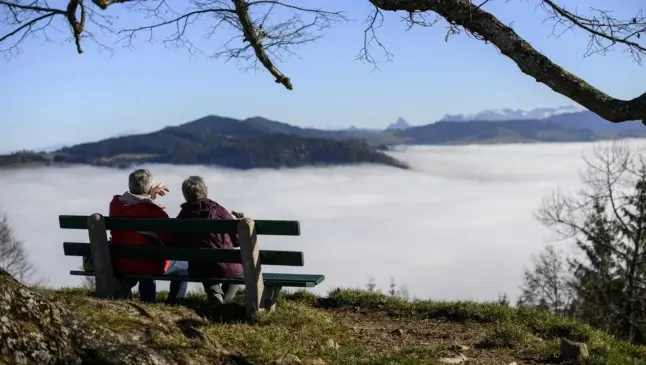
An 2025 YouGov survey has concluded that Switzerland is home to Europe's happiest retirees.
Nowhere in Europe is the proportion of the retired population as happy with their lives as in Switzerland, the survey revealed.
One small caveat to add perhaps is that the survey was carried out on behalf of.... the Swiss Life insurance company.
A couple of the conclusions were also a little obvious: On average, people on high incomes were more satisfied than those on low incomes and... the poorer the subjective state of health, the lower the overall level of satisfaction.
Whilst a little scepticism of the findings is natural, it's not the only survey or study that has suggested Switzerland is the best country in the world to grow old in.
In 2024 The Global Retirement Index found Switzerland to be the only nation to rank in the 'top 10' sub-categories: retirement finances, material well-being, health, and quality of life.
Despite its high cost of living — a definite disadvantage read more about this below) — which makes it difficult for some people to make their ends meet, Switzerland is nevertheless a good place to spend the proverbial “golden years.”
Before we look at the reasons why that is, what exactly is considered 'old' in Switzerland?
Just as a point of reference, in the context of this article 'old' means post-retirement, though many people in this age bracket don't feel, or think of themselves, as "old."
The statuary retirement age in 2024 is 65.
Even though the retirement age for women was raised from 64 to 65 in June 2021 — to start going into effect from 2023 — it still lower than in some other European countries, such as Italy, Iceland, Norway and Greece, where people stop working at 67.
This means that people in Switzerland are still relatively young when they retire — after all, according to one piece of common wisdom, 60 is the new 40 — so they can enjoy many perks in their later years.
And, at least according to the survey, there is no better place to do this than Switzerland.
This is why:
Longer, healthier lives
All the metrics show that Switzerland is near the top of the charts in terms of life expectancy of its population.
One such recent study, by the University Center for General Medicine and Public Health, or Unisanté, estimates the average life expectancy is now 85.8 years for women and 82.2 years for men.
The main reasons for the country’s high life expectancy, are “wealth, a sense of well-being, and healthy diet”, the study found.
If you are hoping that eating chocolate and cheese can boost your life expectancy, probably not so much.
But there are several other reasons why this is so.
READ MORE: Why living in Switzerland can prolong your life
Sense of well-being
According to Organisation for Economic Cooperation and Development (OECD), Switzerland performs very well — and better than many other countries — in many categories relating to well-being of its people, including pensioners.
The country ranks above the average not only in income and wealth, but also in health status, social connections, environmental quality, housing, and personal security.
Healthcare
Switzerland has one of the best and most accessible health care systems in the world (even if it is among the most expensive too).
This means high-quality medical care is available to everyone, which becomes even more important as people grow older.
Its health insurance covers all medically-necessary treatments.
In the 2024 study by the German Federal Institute for Demographic Research, it was cited as the main reason for Swiss longevity.
“The Swiss medical system is less overwhelmed than that of its neighbours,” said demographer Mathias Lerch.
“Family doctors have more time to devote to their patients. Also, regular check-ups, early diagnosis, and preventive measures are more common in Switzerland.
According to demographer Philippe Wanner, “Switzerland benefits from a good health structure, and its health system is efficient in international comparison."
In fact, among responses to The Local’s recent survey about why foreigners want to retire in Switzerland, “the quality of medicine” and “the quality of life” were cited as two reasons.
High standard of living
It is not just about income — which is higher than in other countries, though the prices are too.
It goes beyond money: Switzerland and its cities are regularly ranked among the best places to live in the world, scoring highly on criteria such as personal safety, cleanliness, and good infrastructure — all of which are important for seniors.
Take public transport, for instance.
When you are no longer able, or willing, to drive, you can access virtually any point in your local community (or anywhere in Switzerland, for that matter), by the dense, efficient, and mostly punctual transport system.
Social support network
Vast majority — 96 percent — of Swiss residents say they have at least one person they could rely on in a time of need.
This strong sense of community — which is higher in Switzerland than the OECD average — is important as people get older, as it prevents the sense of loneliness and isolation common in old age.
Sports and fitness
Among the reasons seniors in Switzerland are healthy, live longer, and enjoy their lives is that many stay physically active well into their old age.
The country’s stunning landscape and nature also make it easy to for people of all ages to maintain healthy habits.
Seniors on bikes, skis, and hiking trails are a common sight. In fact, they often seem to have more energy and stamina than their younger counterparts.
Leisure and culture
“Senior discount” is commonplace in Switzerland, allowing people to get cheaper movie tickets or pay less for entrance to museums, galleries, and other venues.
Many other places also offer reductions based purely on proof of age.
With all that, it's easy to enjoy getting older in Switzerland.
Comments