
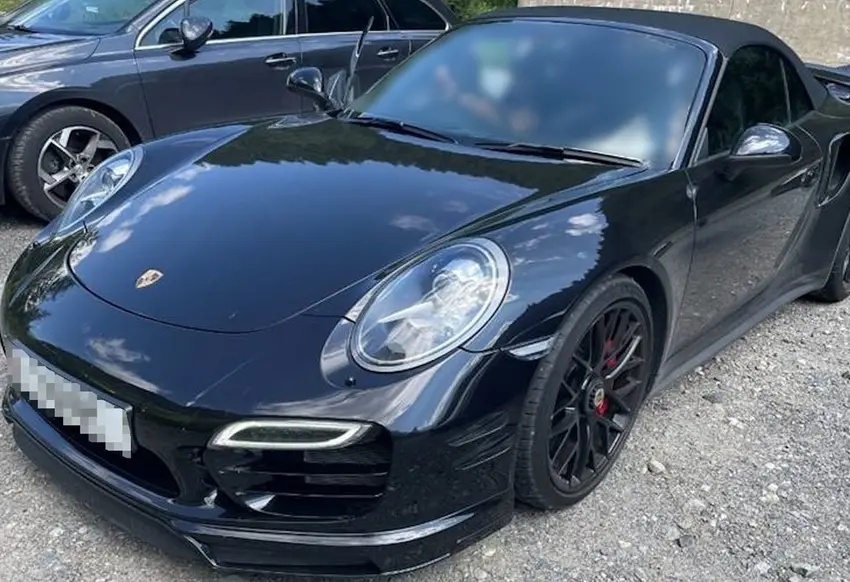
In June, Zurich cantonal police stopped, arrested, and confiscated the cars of four UK nationals who were speeding on a Swiss motorway in their sports cars. They were driving at over 200 km/h, which was 80 km/h over the posted speed limit.
Only a month later, the history has eerily repeated itself: in an apparently unrelated incident, police in Graubünden intercepted two other Brits who were speeding — also in sports cars — through the Flüela Pass.
They dashed through the mountain pass, where the speed limit is 80 km/hour, at 153 km/h, cantonal police said in a press release on Thursday.
Their fate was the same as their other speeding countrymen’s: police confiscated their cars and seized their driver licenses until they appear in (Swiss) court for sentencing.
What will happen to them now?
It will be up to the judge to decide.
However, motorists caught ‘seriously’ speeding on Swiss roads — regardless of their nationality —are typically slapped with a fine of at least several hundred francs (and in many cases even more), in addition to court fees.
The fine can also be converted into a jail sentence if offenders can't, or choose, not to, pay.
So the two speeders will likely have to pay hefty fines, plus possibly the cost of towing their vehicles out of Switzerland, before Brexiting the country.
This is perhaps a good time for a general reminder about speeding fines
It depends on where you are caught and how fast you were driving.
If you exceed the speed limit by up to 5 km / h, your fine will be 20 francs on the motorway and 40 francs if the infraction happened on main or secondary roads.
The fine for driving between 6 and 10 km / h over the legal limit is 60 francs on the motorway, 100 on the main roads, and 120 francs in built-up areas.
Driving 11 to 15 km/h over the maximum speed will cost you 120 francs on the motorway, 160 on the main road, and 250 in built-up areas.
For serious speeding offences in excess of 25 km/h, additional penalties will be imposed.
READ MORE: What are the punishments for speeding in Switzerland
For instance, your driver’s license may be suspended for a period ranging from one to three months, depending on the speed and the location.
Additionally, if you exceed the speed limit by 25 km/h in built-up areas, 30 km/h on main roads, or by 35 km/h on the motorway, your offence will be recorded in the register of criminal convictions and will remain there, for all to see, for a certain period of time.
It would not look good if you are looking for a job or an apartment, as employers and landlords routinely ask to see a copy of your criminal record.
Also, if you cause an accident while speeding or if you drive drunk, penalties would be more significant.
Are rules the same for foreign drivers?
Now, you may think that speeding in a non-Swiss car will offer you immunity from having to pay a fine. But if you believe that, you are wrong.
If you got caught in Switzerland, but live in the European Union, expect your Swiss fine to arrive in the mail eventually.
That’s because Switzerland and the EU share details of drivers who are caught committing traffic infractions on their respective territories.
This data is shared via the European Car and Driving Licence Information System (Eucaris), which holds records of all vehicle owners in Europe.
More relevant to the speeding Brits: living outside of the EU doesn’t protect them from consequences. The fine-recovery process is a little different, but you are not quite off the hook.
READ ALSO: Do I have to pay a fine if I get caught speeding in Switzerland in a foreign car?
Comments