
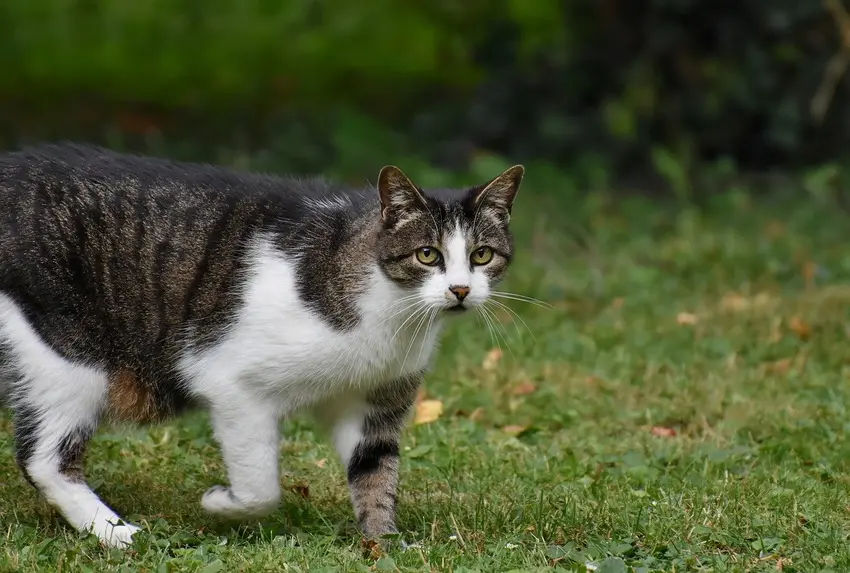
About 1.85 million cats currently live in Switzerland, a number that includes both indoor and outdoor felines.
While the indoor cats don’t pose any problems, the ones that roam outdoors are bad for biodiversity, according to the Swiss Climate Protection Association, which is planning to bring this issue to the ballot box.
The initiative, which the association wants to launch by the end of 2024, calls for limiting the population of outdoor cats for the next 10 years, by banning both import and domestic breeding.
How are cats bad for biodiversity?
They may be soft, fluffy, and cuddly, but outdoor cats are notorious hunters and, according to the association, kill an estimated 30 million birds a year, in addition to a further half a million lizards, frogs, toads, and dragonflies — all of which are essential for biological diversity.
That is why, “cats should be kept indoors,” according to Beat Akeret, spokesperson for the association. “This way, they can’t cause any damage.”
A handful of cantons and municipalities have already proposed measures to curb the spread of cats — mostly by making cat ownership a bit more onerous.
One Aargau MP, for instance, called for compulsory registration of all cats, which would involve paying fees that would ideally serve as a deterrent and ultimately reduce the number of "ill-considered” cat purchases.
In the city of Bern, a cat fee was also discussed.
But both proposals have led nowhere so far.
The cattle too
But while the cats’ innate hunting instinct is damaging to other living creatures, cows also harm the environment - albeit in another way.
They not only produce milk and meat, but they also emit methane and nitrous oxide, powerful greenhouse gases that contribute to global warming.
According to the Federal Office of Agriculture (Agroscope), cattle are responsible for 83 percent of methane gas emissions and 64 percent of nitrous oxide emissions in Switzerland.
"Methane emission occurs chiefly in the dairy and livestock sector, during the digestion of fibrous feed in the rumens of ruminants (cows, cattle, sheep and goats)," Agrosope said.
However, there is no talk about banning or limiting the number of cows — not only because they are essential for milk production (and therefore cheese and other dairy products), but also because Swiss people just love their cows.
Instead, the focus is on mixing methane-reducing additives (which are not toxic to the environment) into the cows' feed.
Comments