
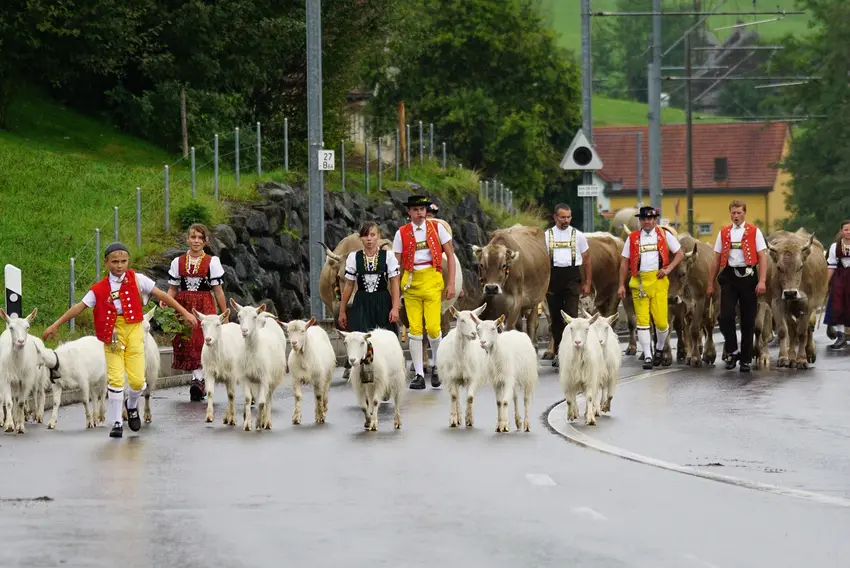
The Alpabzug (German) or Désalpe (French) is the name given to the annual procession of shepherds and their charges at the end of summer.
They move from the Swiss alpine meadows where they’ve spent the warmer months feeding on the more nutritious grass, to the valleys along routes barely changed for centuries.
It’s a tradition thousands of years old, with fragmentary physical evidence suggesting that herds were being moved from Swiss mountain pastures as early as 3000 BC.
While more modern methods have been developed to bring cattle down from the mountains, the annual cattle drives are still the preferred method for farmers and are an essential part of Swiss culture.
READ MORE: Do Swiss cows really get airlifted down from the Alps after summer?
More than just a simple seasonal procession, this is a chance for the shepherds - and their cows- to dress up and celebrate their role within the community.
Shepherds change into traditional dress for the processions, while the cows are draped with garlands of flowers and laden with bells - they can be heard long before they’re seen!
There are lots of #Swiss #cowparades and alpine festivals on these next couple of weekends in #Switzerland Take a look here: https://t.co/9YyRVpqtHE#alpabzug pic.twitter.com/cF1xYSX9L7
— NewInZurich (@NewInZurich) September 14, 2023
One particularly spectacular sight is the lead cow, who is traditionally adorned with the most intricate and outlandish flower crown, handmade by farmhands.
Once the herd and their human helpers have reached their destination, a party with plenty of music, beer and food usually takes place. Watch for the distinctive traditional dances, where young men dance to the noise of cowbells they drape around their necks.
READ ALSO: Why are cows so sacred in Switzerland?
When and where to see the Alpabzug/Désalpe
These alpine processions always occur at the end of the summer, with most occurring from mid-September to mid-October.
The processions are also evenly distributed across Switzerland’s mountain regions - although the Appenzell region, as well as the cantons of Fribourg, Vaud and Valois seem to have a particularly strong tradition.
Several have gained an international reputation due to their spectacle.
The Désalpe at St Cergue, in the canton of Vaud, is one of the country’s largest, with over 700 cattle taking part. It takes place on September 28th.
In addition to the cow procession, the Alpabzug at Urnäsch in the canton of Appenzell Outer Rhodes is known for the piglet races that are bet upon by attendees. You'll have to wait until next year, however, as this year's procession took place on September 14th.
The Désalpe at Charmey, in the canton of Fribourg, is distinguished by the elaborate nature of the flower garlands and crowns worn by the cattle. Like St Cergue's procession, it takes place on September 28th.
September is the month for Alpabzug in Switzerland ???????— when the farmers bring the cows home.
— ethoventures (@ethoventures) September 8, 2023
?Lauterbrunnen Switzerland ?? pic.twitter.com/vycgqzmh97
Over the next two weeks, a number of processions are taking place.
The Alpabzug at Iseltwald, in the canton of Bern comprises 70 animals and takes place on September 21st.
Guard's Alpabzug, in the canton of Graubünden, is distinguished by its goats. It takes place on September 28th.
Finally, the Entlebuch Alpabzug in the canton of Luzern looks set to be among the country's biggest. It also takes place on September 28th.
A full calendar of the processions can be found here.
Comments