
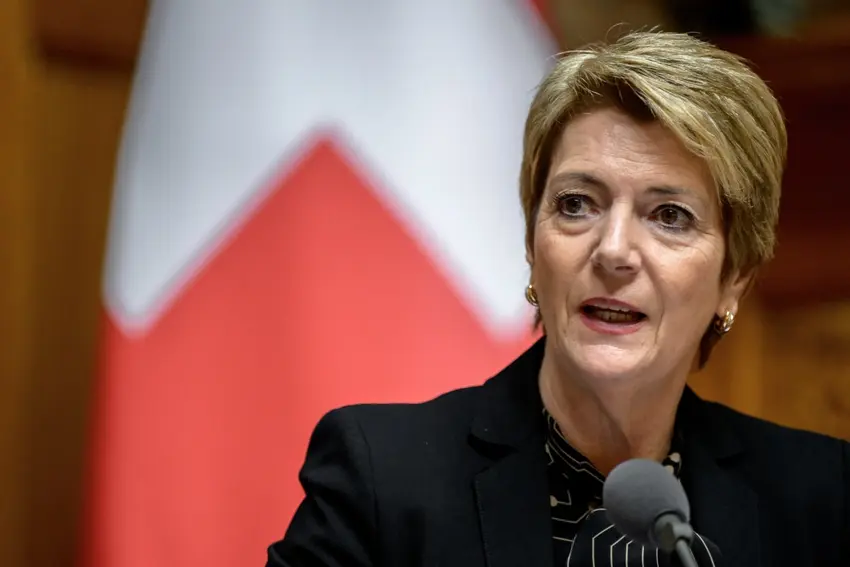
On December 11th, both chambers of the Swiss parliament elected (as they do each year at this time), the member of the Federal Council who will serve as Switzerland’s president from January 1st 2025 until December 31st, 2025.
Karin Keller-Sutter was next in line for the post, having served as the vice-president to the current president, Viola Amherd.
What do we know about her?
Keller Sutter, 61, is the councillor in charge of the Federal Department of Finance, a role she has had since 2023 and will continue to fulfill during her term in office as well.
Prior to that date, the St. Gallen native and a member of the Liberal-Radical Party (PLR), headed the Federal Department of Justice and Police from January 2019 — when she was first elected to the Federal Council.
How are Swiss presidents elected?
The process certainly lacks the drama and the controversy of US elections, and is much more subdued than in other countries as well.
It’s all civil and polite, and works without a hitch, just like the proverbial Swiss watch.
That's because Switzerland manages its politics like it does everything else: in an organised and civilised manner.
The president is chosen by the United Federal Assembly — that is, both chambers of the parliament. This is mostly ceremonial, since everyone knows ahead of time who is in line for presidency in a given year.
Basically, it goes like this: ‘if it’s 2025, it must be Keller-Sutter.”
'Powerless' president
Each of the seven members of the Federal Council gets a shot at a rotating one-year presidency. And if they stay on the Council for more than seven years, they can become president more than once.
Once elected, the president is not the head of state, however.
Probably because seven heads are believed to be better than one, the entire Federal Council acts as the collective head of state. So it would not be wrong to say that Switzerland is a country with seven heads.
This notion may be difficult to grasp, but the entire system is based on the premise that all seven members are equal in status and nobody wields more power or has more clout than others.(In fact, under Switzerland's system of direct democracy, the people, rather than politicians, have the decision-making power — which they exercise through frequent referendums).
READ ALSO: Who is in charge of running Switzerland?
Also unlike other countries, the Swiss president has virtually no power.
Other than representing Switzerland abroad, “he or she chairs the Federal Council meetings and mediates in the case of disputes,” according to the official government site.
In urgent situations, the president can order precautionary measures. In the unlikely event that the Federal Council is unable to hold either an ordinary or an extraordinary meeting, "the president may take a unilateral decision” — the latter being the only bit of “power” the president can wield.
Why does a president only serve one year?
It is because a year is considered long enough.
The 12-month rotation, a system that has been in place since the first Swiss president, Jonas Furrer, took office in 1848 (and left it in 1849) serves to ensure that nobody gets too comfortable or too power-hungry in this position.
So far, this system has served Switzerland well, and the country is none the worse for it.
And if you are concerned that you won’t remember who is president in a given year — neither do the Swiss.
Comments