
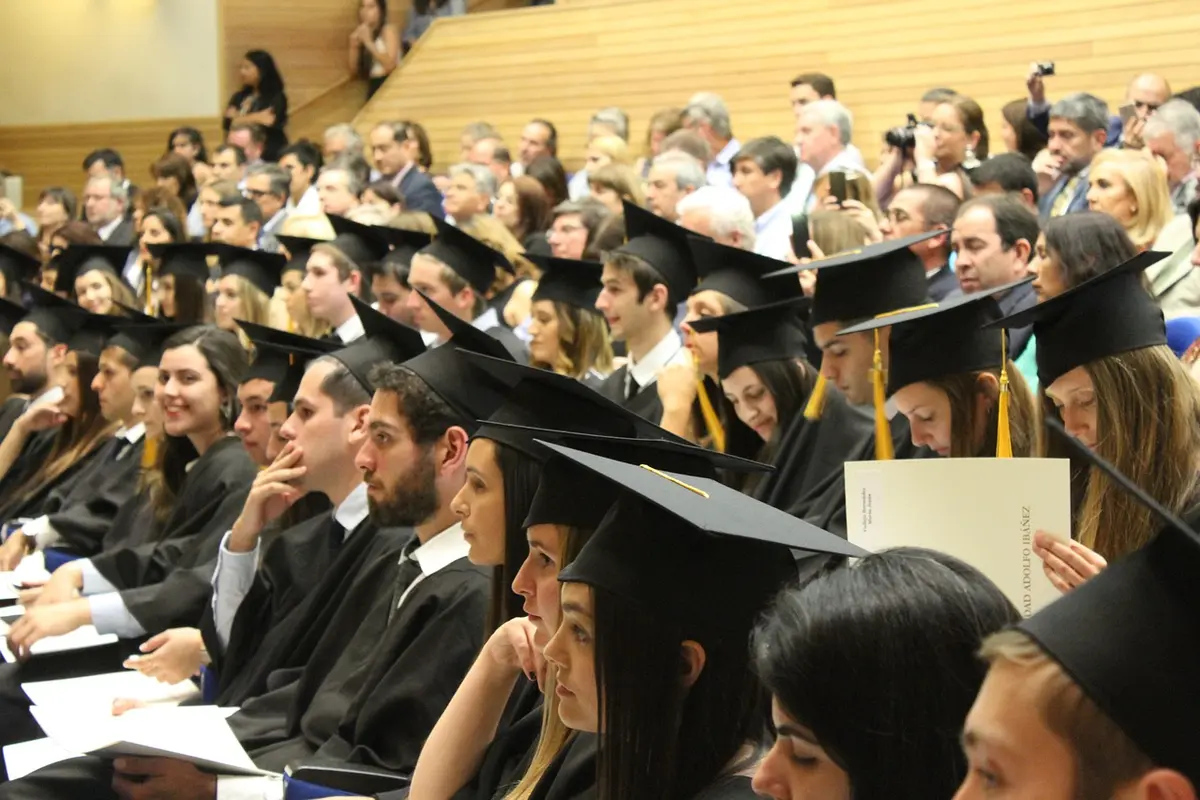
During the academic year of 2022/2023 (the last for which statistics are available), some 76,257 foreigners were enrolled in Swiss universities — a huge jump from just a decade previously, when 53,578 people from abroad attended.
By far the highest proportion of foreigners are studying in the two polytechnic institutes: the ETH in Zurich and the EPFL in Lausanne.
At ETH, about 35 percent of the 21,000-strong student body are foreigners.
At EPFL this proportion is even higher — about half of the total of 13,000 students come from abroad.
But there is a challenge for them ahead: higher tuition fees.
Until now, international students paid the same fee to study at the two elite universities as their Swiss couterparts: 730 francs per semester.
From the fall semester of 2025, however, the fees will triple to 2,190 francs for Bachelor's and Master's degree students (but not for those studyng for their doctorates).
Why will this happen?
These increases are meant to compensate for lower federal contributions because from 2025, the government's financial aid to the two public institutes will be sharply reduced.
Due to budget constraints, the 100 million francs that the government has contributed in the past to the two polytechnics was cut. On December 19th, the parliament has nevertheless decided on a 50-million contribution over the next four years — that is, 12.5 million per year for the two universities.
This means that the budget is still much lower than it used to be, which will be reflected in higher tuition fees for foreign students. But only those enrolling in the autumn of 2025 will be affected by the hikes; students already studying at the two schools will continue to pay the ‘old’ fees.
However, even with the hike, the fees at the two institutes will still be considerably lower than at similarly high-ranked universities abroad.
Does this measure apply only to foreigners?
Yes.
The reason for what may appear as unequal treatment is that public higher education institutions in Switzerland are funded mostly by taxpayers, so it is logical that Swiss students would have a 'preferential' treatment in this regard over those coming from abroad.
Cantons provide the main share of public education funding for the cantonal universities and universities of applied sciences on their territories, while the federal government makes financial contributions.
READ ALSO: Two top Swiss universities triple tuition fees for foreign students
What about other public universities in Switzerland?
Nothing is written in stone yet, but some are debating a similar move.
The University of Geneva (UNIGE), for instance, has been considering raising tuition fees for non-Swiss students — currently, UNIGE is one of the least expensive colleges in the country, charging students just 500 francs per semester, regardless of their nationality.
But any changes in the fee structure will not go into effect in 2025, as these matters have to be decided ahead of time — as has been the case with the two polytechnics.
There may also be other changes ahead, but not in 2025
Just so you know what is being debated for the future, the EPFL is seeking to limit the number of foreigners it admits each year.
That’s because the number of students at EPFL more than doubled in the last decade, "creating a number of challenges when it comes to maintaining our high educational standards,” the university said at the beginning of 2024.
"Our lecture halls are saturated, the student-faculty ratio is on the rise, and the workload for our support services has expanded considerably.”
If this measure does go into effect, it will affect non-Swiss students only.
Comments