
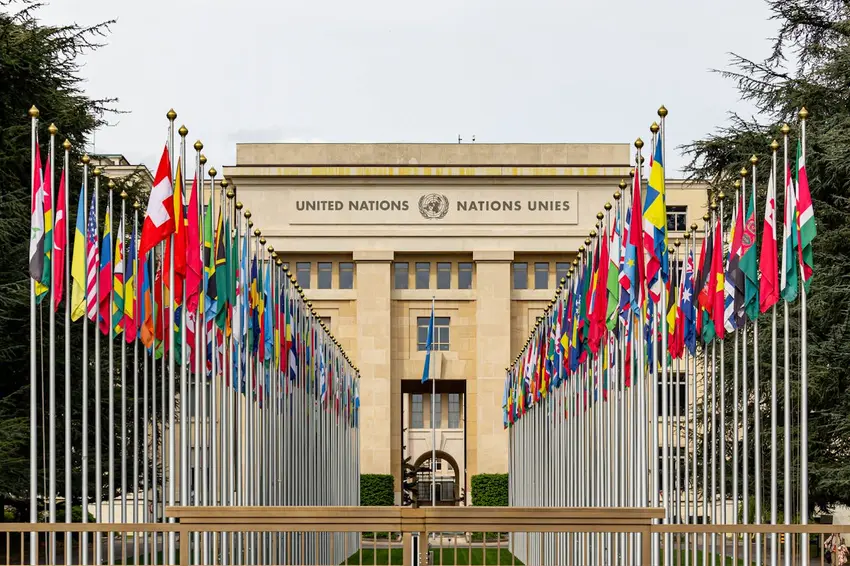
As soon as he was inaugurated on January 21st, US President Donald Trump announced his intention to withdraw the United States from the Geneva-based World Health Organisation (WHO).
He has since added other UN agencies (including in Geneva) to his 'to be axed' list).
Trump has often said he dislikes multilateralism, defined as an alliance of multiple countries pursuing a common goal.
That would aptly describe the more than 40 international organisations that are based in Geneva.
It is therefore possibly not surprising that one of Trump's earliest moves as the president was announcing the withdrawal from the WHO, an agency whose aim is to fight the world’s toughest public health problems.
The US will officially withdraw in 2026 after a formal request was made.
The WHO employs 2,400 people from around the world, although it is not known how many of them are American nationals. The US, which contributes 18 percent of the WHO's funding, has already recalled all its government personnel working with the agency.
Experts predict Trump will continue pulling the US out of UN agencies, which would likely have a huge negative impact on Geneva.
The WHO is just one of the many UN entities based in Geneva. The UNHCR and the International Organisation for Migration are just two of many others.
Overall the US currently contributes around 26 percent of the funding for Geneva's international organisations. If that was cut, the future of the organisations and their workers would be thrown into doubt, not least for the American staff.
'Serious consequences' for Geneva
The simple fact is that the UN and other international organisations are major economic drivers for the Geneva region.
In all, over 35,000 workers from more than 190 countries, are employed throughout the international organisations, which are described under the umbrella term "International Geneva". Thousands more are employed by the hundreds of NGOs based in Geneva.
In all, around 10 percent of jobs in Geneva are with international agencies or NGOs.
The 33,000 workers all generate revenues for local businesses and service industries, including travel, retail, health, and real estate market.
That's not to mention the thousands of delegates who travel to the area for one of the 5,000 annual conferences each year. There are more than 4,000 annual visits of heads of state and government, ministers and other dignitaries.
According to the Swiss government: "International Geneva is an essential component of Geneva's identity and acts as a major economic driver for the whole of the Lake Geneva region."
Micheline Calmy-Rey, former Swiss president and member of the Federal Council, warned that US withdrawals would have “serious consequences on the economy of Geneva."
“Geneva has a cause for concern," she said.
"We do not know to what extent he will cut contributions", nor "how far" they will go, nor "if they will be accepted by Congress," said Calmy-Rey.
"But it will have an impact on the economic life of the region", namely "Geneva, the canton of Vaud and neighbouring France", she said, and on the 33,000 jobs.
What could be next?
Given Trump's denial of global warming and promise to leave the Paris Climate Agreement, he may pull the US out of the World Meteorological Organisation and, also in line with his beliefs, the UN Refugee Agency and the World Trade Organisation as well, to name just a few.
All of them are based in Geneva.
READ ALSO: What Trump's return means for Switzerland
The French communities that are bordering Geneva (the so-called 'Greater Geneva area') would also be impacted.
That's because some UN employees — including Americans — live in those communities, so their departure would affect those areas as well.
Calmy-Rey says she is confident the organisations would survive if the US pulled out but they would be forced to seek funding from other sources.
"There are other countries"... than the US, she said.
What are Geneva authorities doing to counteract the disappearing US funds?
In order to save these international bodies — and the tens of thousands of jobs they create — the local government is trying to find other sources of financing.
A bill aimed at temporarily helping employees of affected agencies will be urgently sent to the Geneva parliament, according to deputy Delphine Bachmann, head of the Department of Economy and Employment.
It provides for 10 million francs to allow employees whose jobs became redundant after the US withdrawal to nevertheless receive a salary for three months.
Bachmann conceded that these measures would be only temporary, but they would give Geneva authorities more time to come up with a long-term plan.
Would you be affected by any US withdrawal from Geneva's international agencies? Email us at news@thelocal.ch or leave a comment below.
Comments