

If you are already working in Switzerland, this means you have a sufficient level of language proficiency for the type of permit you received.
That’s because the State Secretariat for Migration (SEM) has rules about how fluent you need to be in a national language of your place of residence to be eligible for a permit. It is based on the Common European Framework of Reference for Languages (CEFRL).
It looks like this:
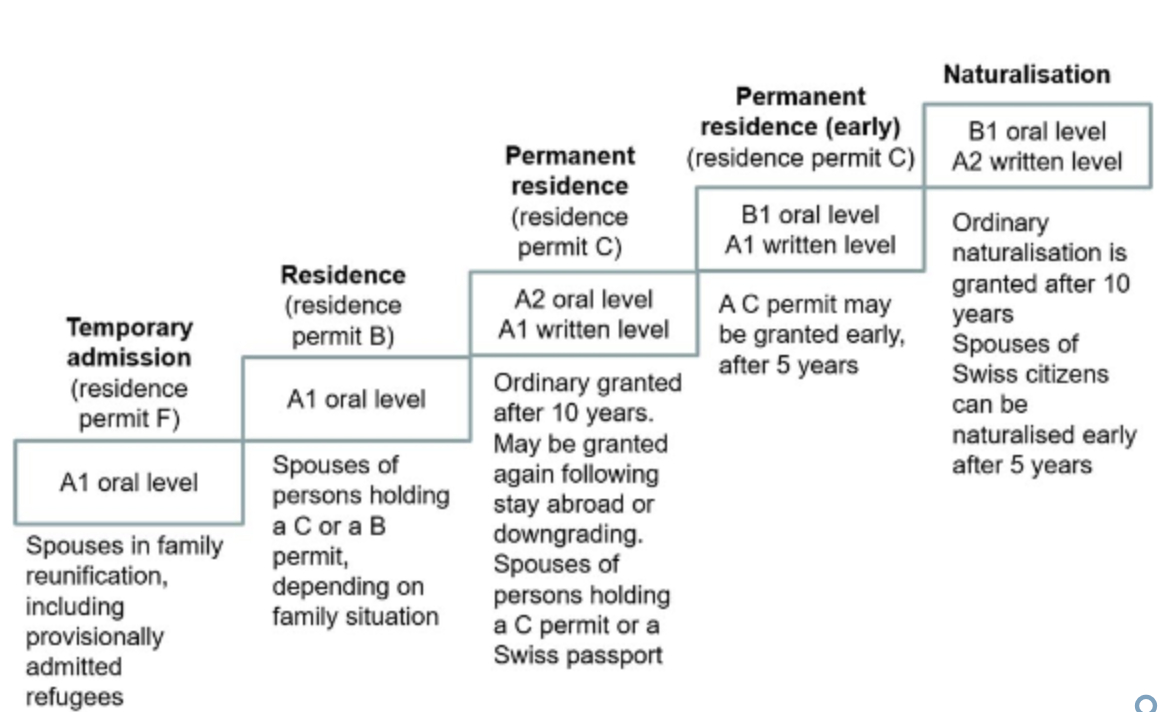
This means that requirements are lower B permits than for permanent residency (C), and naturalisation. (But beware, that some cantons have even tougher criteria).
This is how did works in practice
To obtain a B permit, which is what foreigners usually get when they first come to Switzerland, you need to take a FIDE-certified exam which attests to your level.
FIDE is a body that gives accreditation to language centres and authorises them to conduct language testing.
There are accredited centres all over the country.
In addition, other tests can also be taken throughout Switzerland, which are recognised by SEM.
Once you pass the test, that means your language skills are sufficient or this type of permit, and you should not worry that it will be taken away solely based on language.
(There are some exceptions to this rule, however: if you are of German, French, or Italian mother tongue and will work in the language-appropriate region, you are exempted from tests.)
Here’s where you may have a problem with permit renewal
Let's say you have the appropriate level for the B permit (A1 oral), but you have lived in Switzerland long enough —five years for citizens of the EU and EFTA states (Norway, Iceland, and Liechtenstein), as well as North America, and 10 years for other third-country nationals — to be eligible for the C permit.
If your proficiency in the language of the region has progressed during the years you have been living in Switzerland and you pass the A2 oral and A1 written level (or A1 written and B1 oral if you apply after five years of residency), then all is well.
The only problem that could arise is if your proficiency has not evolved beyond the very basic A1 oral level in the time it takes to go from the B to C permit.
In such a case, your B permit will not be cancelled (as you already have the required A1 level), but your chances of progressing toward C are nil.
There are, however, other reasons, aside from language considerations, why your permit may not be renewed:
READ ALSO: The reasons Swiss authorities could refuse to renew your work permit
Are there any exemptions to the language rule for permits?
Yes.
According to SEM, “if the applicant is unable to meet the language requirements or can only do so with difficulty, an exemption may be granted. This may be because of serious personal circumstances such as a physical or mental disability, learning difficulties or a serious or chronic illness.”
Such an individual “must submit proof of their inability to meet the legal language requirements.”
Comments