
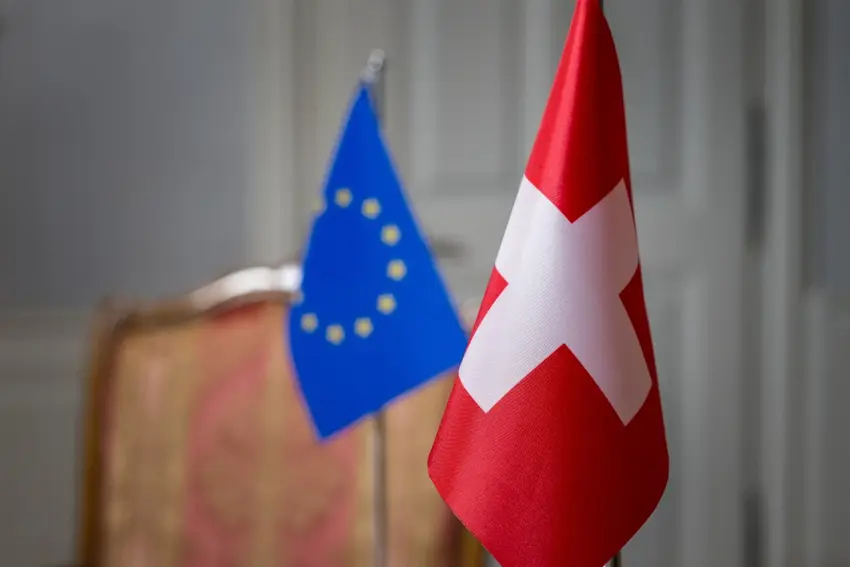
As a reminder, the safeguard clause is intended to limit the free movement of people from EU countries into Switzerland to protect the labour market and the country’s social welfare system in the event of a sudden rise in immigration from those countries.
In such cases, Bern has had the right to invoke this clause unilaterally — that is, without the EU’s consent.
During the negotiations, however, this provision caused a protracted tug-of-war, with the Swiss insisting on keeping the law intact, while officials in Brussels insisted the provision went “a step too far.”
In the end a compromise of sorts was reached, with both sides having to modify their initial expectations.
What happens now?
From the EU’s perspective, “the main change will be that Switzerland will apply current and future Union law on free movement of persons and posting of workers, and therefore be subject to the same rules as Member States.”
Further, “Switzerland cannot place a cap on free movement and this will not change with the updated agreement. The existing safeguard clause will be concretised and framed, but it will not be unilateral.”
So the major take-away here is that Switzerland can maintain this clause somewhat, but not activate it without discussing it with the EU first.
Additionally, in order to maintain the safeguard clause (in amended form), Switzerland will have to increase its ‘cohesion payments’, that is, its financial contribution to poorer EU states.
Previously, this contribution was voluntary and lower.
Under the new terms, however, the amount of the first contribution for 2030-2036 is set at 350 million francs per year.
How will Switzerland amend its safeguard clause to comply with the new EU agreement?
Experts from the Federal Department of Justice and Police have undertaken the complicated task of deciding what form the amended clause will take.
However, Swiss economists point out that in whichever way Switzerland works out this issue, the EU could still end up interpreting the clause differently from Bern.
In the event of a disagreement, it will be up to an (EU) arbitration tribunal to decide. “But this divergence of interpretation could already herald future tensions between Switzerland and the EU,” Swiss media reported.
A legal challenge
There could be even more complexities ahead for the Swiss.
The bilateral agreement section of Switzerland’s Constitution stipulates that no international treaty may be concluded "if it contravenes this article" — that is, no treaty authorising immigration without a cap can be implemented.
Opinions have been offered to overcoming this particular challenge.
Former federal judge Peter Karlen, said the the constitutional article must be revised and that can only be done via a referendum.
Andreas Glaser, a specialist in public, administrative and European law, proposed submitting the agreement to a mandatory referendum to give it a legal status equivalent to the constitutional article on immigration.
The State Secretariat for Migration (SEM) pointed out, however, that "the outcome of the negotiations in the current agreement does comply with the constitutional requirements.”
At this point, therefore, it remains to be seen what the government works out in terms of an updated safeguard clause,
Comments