
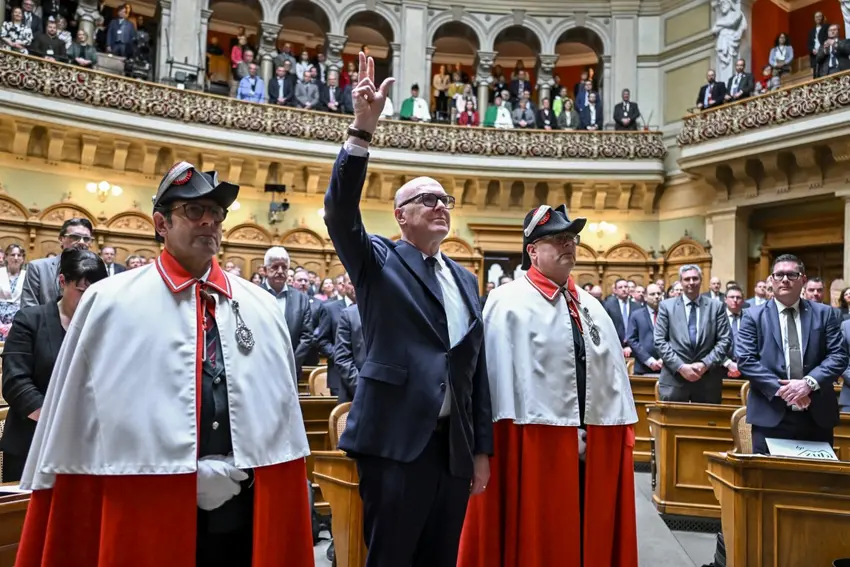
The new Federal Councillor Martin Pfister, 61, an army colonel, was elected Wednesday morning by the 200-seat National Council and the 46-seat Council of States.
Like Amherd, Pfister is also a member of the Centre party, in order to preserve the balance of parties that have been represented in the Federal Council for over 60 years.
The composition of the Federal Council also represents that of the Parliament.
It is based on the so-called ‘magic formula,’ which means two seats each are attributed to the Liberal-Radicals, Social Democrats, as well as the Swiss People’s Party, and one seat for the Centre.
Why is this formula referred to as “magic”? Possibly because the power is not vested in one individual, but is divided among seven people, therefore ensuring that a single person can't become too powerful, at the detriment of others.
Who is Pfister?
Pfister, 61, is the health minister in his native Zug canton in central Switzerland and cuts a rare figure in the Swiss government, having never served in the national parliament.
"I know the barracks better than the Federal Palace," he said, in his first speech before lawmakers.
"Switzerland's foundations -- trust, cooperation and stability -- have recently undergone some upheavals, both at home and abroad.
"We may be facing major geopolitical changes that will be particularly challenging for Switzerland in the coming years," notably in security policy, he said.
What will Pfister’s role be?
He will take over the Defence Department, which is not necessarily a good choice for the incoming minister, so it will be a baptism by fire of sorts.
That’s because the department has been shaken up by a scandal of late, involving fraud, leaks, accusations of back-stabbing and, ultimately, resignations of two top officials.
READ ALSO: What is the scandal shaking up Switzerland's Defence Department all about?
Do ministers have a choice of the department they will head?
Up to a point.
The parliament elects ministers who are not necessarily specialised in any given field, so they ‘learn’ on the job.
Personal affinities can play a role in this allocation, however.
And the principle of seniority applies — in other words, the oldest member of the Federal Council may express his or her wishes first, and the most recently elected member (in this case, Pfister), does so last.
As a rule, however, no one can claim a specific department.
According to the government, "the Federal Council allocates departments among its members, who are required to accept the department assigned to them. The Federal Council may change the allocation of departments at any time."
These are the seven ministries / departments and he Federal Councillors in charge:
- Interior Ministry: Elisabeth Baume-Schneider
- Foreign Affairs Ministry: Ignazio Cassis
- Justice and Police: Beat Jans
- Finance Ministry: Karin Keller-Sutter (this year’s president of Switzerland)
- Economy Ministry: Guy Parmelin
- Defence Ministry: Martin Pfister (replacing Viola Adhered)
Most of these ministries also have ‘sub-departments’ — for instance, the Interior Ministry oversees the Pubic Health department as well as the Social Insurance office, among others; the Economy minister is also in charge of the State Secretariat for Education and Research; while the Justice and Police oversees the State Secretariat for Migration.
Last but not least: what does the Federal Council actually do?
According to a government site, its tasks include implementing the laws passed by the parliament and approved in a referendum; managing federal finances; and ensuring Switzerland’s security.
Further, “the Federal Council reaches its decisions as a collegial body. Each member of the Federal Council has equal status. The president chairs the meetings but does not have any special rights. Consensus is sought in the decision-making process; an actual vote is rarely held. All members of the Federal Council must represent the government’s decisions to the public, even if they personally are of a different opinion or the decisions contradict their party’s line.”
Swiss government ministers earn an annual gross salary of 477,688 Swiss francs ($541,650), plus an annual lump sum of 30,000 francs.
They also get two vehicles, a first class railway pass and a general pass on Switzerland's ski lifts.
Comments