
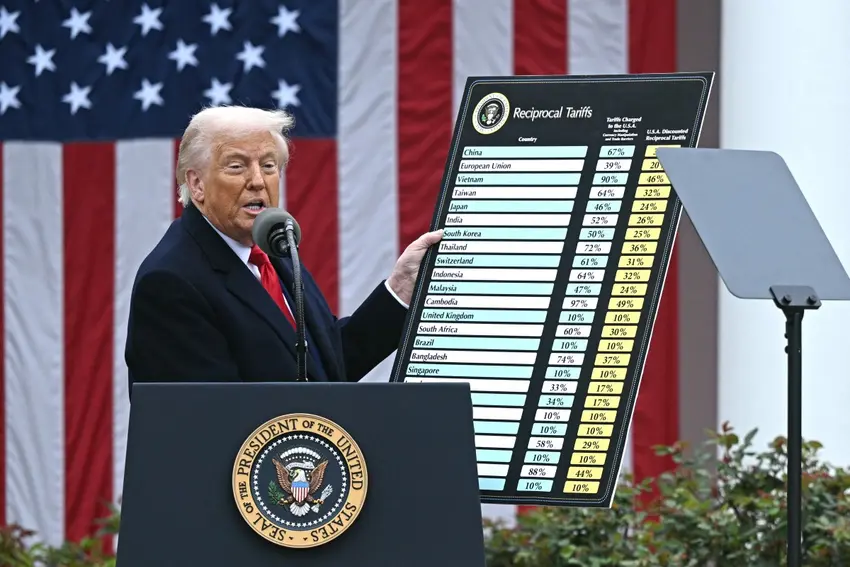
Donald Trump signed an executive order on Thursday evening increasing customs duties for dozens of countries.
According to the list published by the White House, imports from Switzerland will be taxed at a whopping 39 percent.
This tariff is higher than the 31 percent levy originally announced in April, and also higher than the Swiss government had hoped after negotiations with the Trump Administration.
It is also far higher than the 15 percent levy on EU goods that Trump agreed with EU chief Ursula von der Leyen on Sunday.
The Federal Council has received this news "with great regret," the spokesperson for the Federal Department of Finance (FDF) said, adding that "Switzerland continues to seek a negotiated solution with the United States," to lower the customs duty.
The new tariffs will do into effect on August 7th and would also prove painful for Switzerland's manufacturing and watchmaking industries.
The Swiss government said it remains in contact with US authorities and "still hopes to find a negotiated solution...", it said in a statement on X.
However there were strong reactions among Swiss political parties.
The centre-right Radical-Liberal Party said in a statement: "President Trump's decision is a catastrophe and a direct attack on our prosperity.
"The United States is sabotaging not only the very good and reliable relations it has maintained with our country for decades, but also free trade as a whole," the party insisted.
"The Federal Council notes with great regret the intention of the US to unilaterally burden Swiss imports with considerable import duties despite the progress made in bilateral talks and Switzerland's very constructive position," it added.
READ ALSO: Why has Trump hit Switzerland with such high tariffs?
Senior Swiss officials had held numerous discussions with their US counterparts in an attempt to reach a deal with the administration of US President Donald Trump, like Britain and the European Union have.
President Karin Keller-Sutter, who is also finance minister, spoke with Trump on Thursday.
"The trade deficit remains the centre" of Trump's preoccupation and they could not reach an agreement on a framework trade deal, she said on X.
Before the tariff announcement Keller-Sutter had warned that the future of Switzerland and its economy was in the hands of Trump.
“It is now in the hands of the United States, in the hands of President Donald Trump," she said.
The president emphasised the limited influence that Switzerland has globally, as "a small country."
"We are not a superpower. We have some economic clout, but not political power [like the EU]. We have to live with that," she said.
The United States is a key trading partner for Switzerland, taking 18.6 percent of its total exports last year, according to Swiss customs data.
Pharmaceuticals dominated at 60 percent of Swiss goods exports to the United States, followed by machinery and metalworking at 20 percent and watches at eight percent.
The trade balance was heavily in Switzerland's favour at 40 billion Swiss francs ($49 billion) last year.
Trump has paid particular attention to trade deficits, considering them a sign that the United States is being taken advantage of by its trading partners.
Switzerland is however the sixth country in terms of foreign direct investment into the United States, particularly in research and development.
Swiss pharmaceutical giants Roche and Novartis have both announced plans to invest tens of billions of dollars in the United States in the coming five years as they try head off threats by Trump to impose separate tariffs of up to 200 percent on medicines if foreign drugmakers don't move more production into the United States.
The trade association representing the small and medium-sized firms in Switzerland's machine and metal-working industry urged the government to take advantage of the negotiating window before the entry into force of the new tariffs which it warned would have serious long-term consequences.
With reporting by AFP
Comments (1)