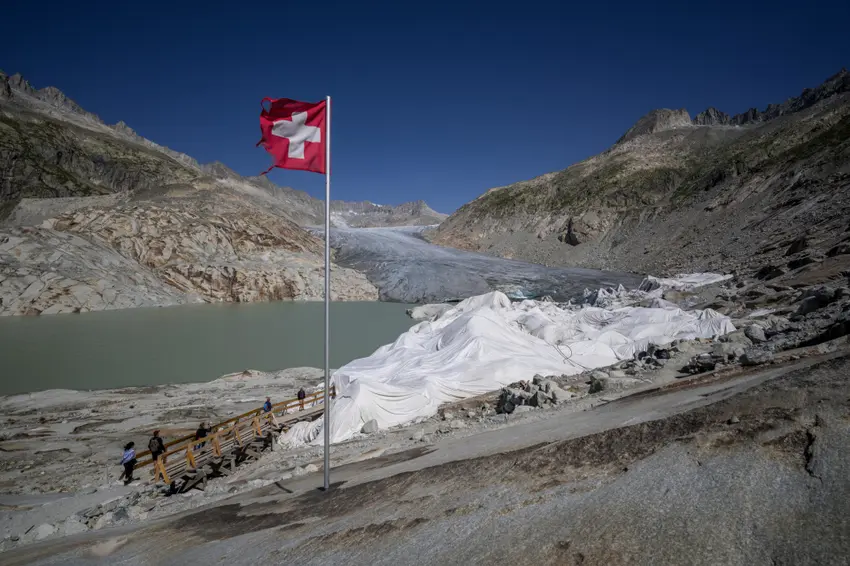
A government report has laid bare the future of Switzerland's climate, with less snow, rising temperatures and more extreme weather on the way, according to forecasts.
The medium to long-term projections foresee more "heat warnings in summer, increased droughts, winters with little snowfall, and more intense and frequent heavy rainfall with flooding", the report claims.
The report, published by MeteoSwiss on behalf of the Federal Department of Home Affairs, breaks down Switzerland's exposure to certain types of climate change and the real world weather impacts they could have in the medium-term future.
As per MeteoSwiss' summary graphic below, Switzerland has already been impacted by a whole host of different and intersecting climate challenges that could be worsened by temperature rises above the key 3C threshold moving forward.
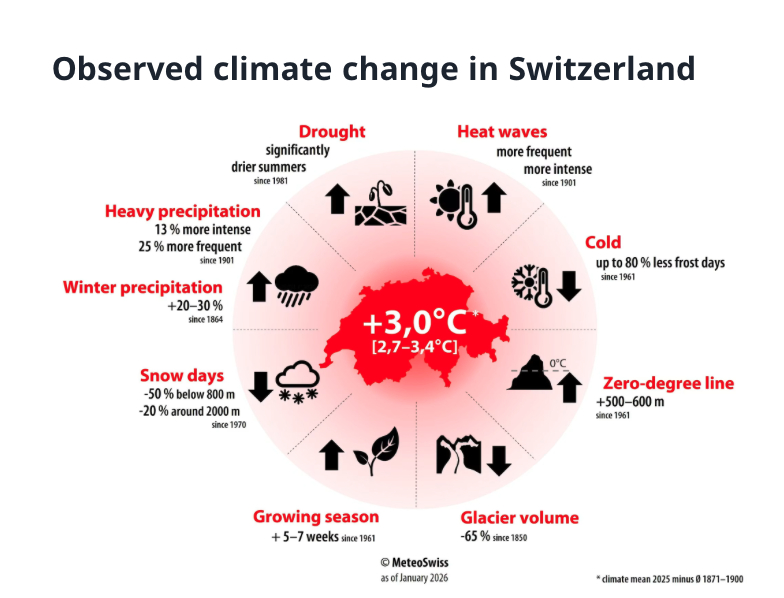
The study shows that the Swiss climate has already suffered several profound changes in recent decades
Notably, glacier volume is down a staggering 65 percent since 1850. There have been 80 percent less frost days since 1661.
Looking ahead, the document also highlights that Switzerland could be particularly at risk in numerous ways.
Heatwaves
Despite long being known as a world-class ski resort, if climate change forecasts are correct and temperatures continue rising at the rates foreseen by experts, Switzerland will be increasingly hit by heatwaves and extreme temperatures, with the country more at risk than the average country.
"Climate change is particularly evident in Switzerland and is already having a significant impact. In the future, the rise in temperature in Switzerland will continue to be much more pronounced than the global average," the report states.
The study's findings show that Switzerland has already warmed by about 2.9C since pre-industrial times, compared with 1.3–1.4C globally.
Temperature forecasts referenced in the study show that the trend will "continue in the future and that Switzerland will continue to warm faster than the global average."
If global warming hits the 3C threshold, Switzerland could see temperature rises of up to 5C.
Put simply, Swiss temperatures in the future will begin to look a bit more like southern Europe.
Jean-François Bastin, Researcher for Ecosystem Ecology at the Crowther Lab at ETH Zurich, describes it as a climate journey: "In the course of global warming, the climate of many cities is shifting hundreds of kilometres south. Bern is taking a climatic journey to northern Italy / Milan".
Less snow and ice
These temperature rises will have a multitude of other consequences in Switzerland.
As noted, snow and ice cover has already decreased significantly in Switzerland in recent decades and rising temperatures will speed up the process.
"Since the beginning of the 20th century, the zero-degree line in Switzerland has risen sharply. At high elevations, precipitation increasingly falls as rain rather than snow. As a result, snow cover is decreasing and the melting of snow and ice is accelerating," the report states, adding that "this trend will continue to intensify in the future."
The zero-degree line will also rise significantly in summer, accelerating the melting of snow and ice even on the highest Alpine peaks.
"The effects are clear to see, most notably in the form of glacier melt. As an alpine country, Switzerland is affected by these changes," it adds.
Intense heat events
Switzerland can also expect "significantly more frequent and more intense heat events" in addition to higher average temperatures overall.
This is because the data shows that increases in maximum temperatures and extreme heat in Switzerland is greater than the average temperature increases.
Annual maximum temperatures will rise significantly in the future, meaning that heatwaves and so-called "intense heat events" will become more common.
Other longer-term temperature indicators such as tropical nights (when the temperature does not fall below 20C) will also rise.
Drought and forest fires
Increasing temperatures can cause drought conditions and will significantly raise the risk of forest fires, the report concludes.
Over the last half decade, the conditions for forest fires have already increased in Switzerland.
"With even hotter and drier summers expected, weather related risk forest fires will continue to rise. In a 3C world, the number of days with high weather related fire risk will increase compared to the reference period 1991–2020, for example in Sion from 18 to 44 days," the report says.
Freak rainfall
Climate change doesn't only mean higher temperatures, the report also outlines how the conditions create more unstable weather conditions overall, such as freak rainfall and flooding.
"Heavy rainfall events are occurring more frequently and are more intense today than in the first half of the 20th century. With climate change, Switzerland must expect a further increase in heavy rainfall across all seasons in the future," notes the report.
Sudden and intense rainfall will increase the chances of flooding and mudslides.
Comments