
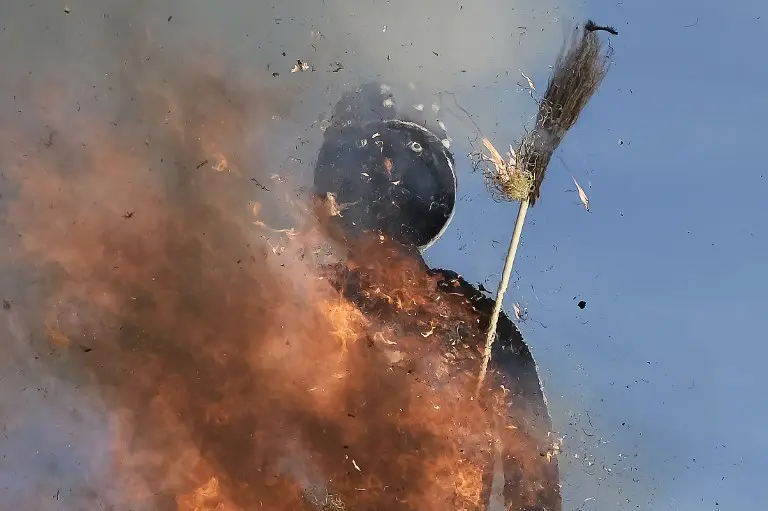
On Monday, Zurich’s huge Sechseläuten festival came to its traditional fiery and noisy end with the burning of the Böögg, a massive snowman packed with explosives whose destruction marks the symbolic end of the winter.
Read also: Why people in Zurich burn a snowman every April
Tradition has it that the length of time it takes for the Böögg’s head to explode predicts the weather for the summer ahead.
Happy Sechseläuten! #BurnTheBöögg pic.twitter.com/OWz53dtoRQ
— The Mighty O (@OmarUnited) April 16, 2018
And with a full 20 minutes and 31 needed until the Böögg’s head exploded yesterday, initial indications are that we shouldn’t get our hopes up.
Last year, by contrast, the snowman’s head was history in just 9 minutes and 56 seconds. What happened next? Summer 2017 was the third warmest since records began back in 1864.
In 2003, the Böögg, which even has its own Twitter account, exploded in a very-brief five minutes and 42 seconds, ushering in the famous ‘once-in-a-century’ summer of that year.
Meine Lieben, es war wieder wunderschön mit euch! Geniesst den Sommer. Ich komme wieder, nächstes Jahr! #sechseläuten BUMM...
— Böögg (@Boeoegg) April 16, 2018
But it should be noted the Böögg has a generally poor record when it coming to predicting the weather.
In 2016, for example, the burning of the famous snowman took a full 43 minutes and 34 seconds to explode, which is the longest time on record. But the following summer was relatively hot and rain-free.
Comments