
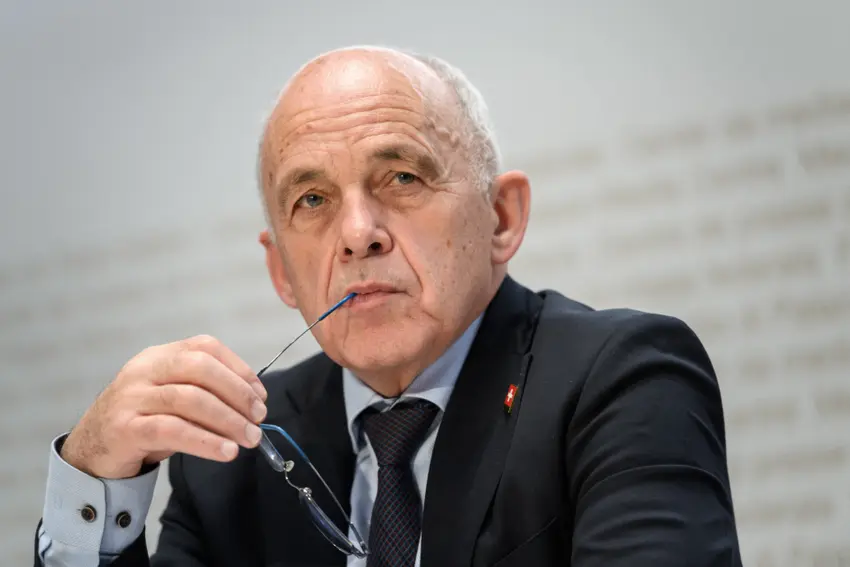
Ueli Maurer, who served as finance minister until his retirement from the Federal Council in December 2022 (and was president in 2019) has found fault with people who obtained their Swiss citizenship through naturalisation, rather than by birth.
In a recent interview, Maurer, who is a member of the rightwing, anti-immigration Swiss People’s Party (SVP), said Switzerland is “demented” to naturalise so many foreigners.
“What worries me is that due to migration, we are losing our identity,” he said.
Maurer also pointed out that once foreign nationals obtain Swiss citizenship and are able to vote in Switzerland, “right decisions” are no longer made at the ballot box.
In response to Maurer's rant, Cédric Wermuth, co-president of Social Democrats simply said that “I am always surprised by how low the SVP can sink."
Many readers of The Local who have become dual citizens would disagree with the comments of the populist Swiss MP. When asked in a survey whether they felt more Swiss after being naturalised most responded "yes".
Jerry Cappellania from Italy said being Swiss "made her feel 'more part of a community” whilst Michael Savage from the United States said becoming Swiss gave him "the feeling of belonging”.
Have you become Swiss? What impact has it had on you? Tell us in the comments section below.
READ ALSO: Are there any downsides to being a dual national in Switzerland?
But that’s not all
Maurer’s party, the SVP, is also intent on banishing naturalised citizens from the parliament.
A number of MPs in both chambers of the parliament are foreign-born but naturalised dual nationals (obviously, Swiss citizenship is a requirement for deputies).
This has prompted one SVP deputy, Andreas Glarner, to submit a motion the parliament to make dual citizens ineligible to run for either the National Council or the Council of States — the two chambers that form the parliament.
The reason he gave is that naturalised MPs “don’t represent Switzerland’s best interests".
This move followed a dispute that Glarner had with another MP, Sibel Arslan, who has both a Swiss and Turkish citizenship.
The two quarrelled publicly when Arslan defended climate protesters gathered in front on the Parliament Building in Bern.
Glarner insulted Arslan in front of TV cameras, telling her that Switzerland is a nation of law and order, "something that doesn't exist in your country."
While Arslan herself stayed mum, other naturalised MPs came to her defence.
Yvonne Feri of Social Democratic Party, who has Swiss and Italian passports, said that she represents the interests of her constituents, “and not of Italy”.
She added that the parliament is a reflection of Switzerland, where nearly 25 percent of the population has foreign roots.
READ ALSO: 'Not to 10 million': What Switzerland's new vote to limit immigration could mean
How many foreigners are naturalised in Switzerland?
Let’s look at 2023, the last year for which data is available.
According to the State Secretariat for Migration (SEM), 41,299 people obtained a Swiss citizenship last year.
In this respect Maurer was correct: the number of naturalisations has steadily increased since the beginning of the 2000s, when only 28,700 foreigners obtained their Swiss passports.
In 2023, half of naturalised citizens came from Germany, Italy, France, Portugal and Spain, and just over a third from the rest of Europe.
The remaining 17 percent were third-country nationals, including the UK.
READ ALSO: Do I have to tell Swiss authorities I'm a dual citizen?
Recent statistics are also likely to vex Maurer and the SVP.
That's because SEM data published on Thursday indicates that 80,684 foreigners immigrated to Switzerland just in the first six months of 2024.
Most (57,330) came from the EU — particularly Germany — as well as EFTA (Norway, Iceland, and Liechtenstein).
Third-country nationals who came to Switzerland between January and June, make up 7 percent of all arrivals.
Americans and Indians constitute the majority (3 percent each), followed by Brits ( 2 percent).
Has becoming Swiss helped you feel more Swiss and have you integrated more? Tell us in the comments section below.
Comments