
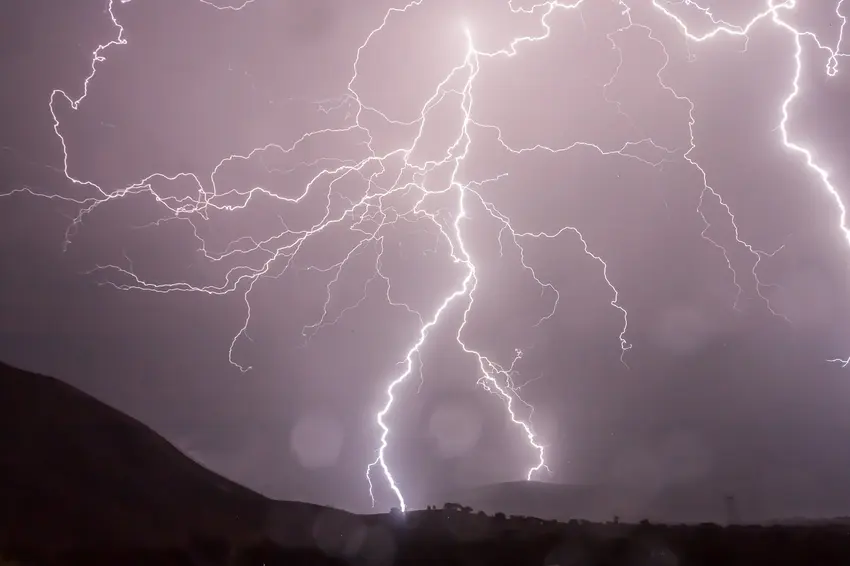
Though Switzerland’s federalist system applies more to politics than natural phenomena, the fact is that the kind of weather you have also depends on where in the country you live.
At least, that is the finding of new analysis carried out by AXA insurance.
You may be wondering what does an insurance company know about the weather?
Actually, a lot.
That’s because assessing weather-related damages and mapping the types of claims by region is part of what they do.
This is what AXA found
Not all regions of the country are exposed to the same weather risks.
For instance, hail-damaged vehicles represent the largest share of claims, both in volume and cost.
In this respect, the cantons of Ticino, Jura, and Neuchâtel have been particularly affected, along with, to varying degrees, Nidwalden, Obwalden, Bern, Lucerne, Schwyz, and Fribourg.
"It is mainly severe hailstorms, damaging a large number of vehicles in a short period of time, that can significantly increase the claims tally," according to Patrick Villiger, fead of motor vehicle claims at AXA.
Such damage is less common Schaffhausen, Geneva, Graubünden, Glarus, and Thurgau, he said.
In terms of flooding, AXA found that Schwyz has had the highest number of flood claims per insured household over the past decade.
Next are Thurgau, Solothurn, and Lucerne.
In contrast, Vaud, Nidwalden, Basel-Country, Graubünden, and Uri have been relatively spared over the past 10 years.
What about lightning?
There is a saying ‘the lightning never strikes twice’ — except for Ticino.
According to AXA, households in the Italian-speaking canton have generated “nearly seven times more claims than the rest of Switzerland over the past decade.”
The risk in Ticino is 26 times higher than in the cantons of Basel-Country, Vaud, and Geneva.
“The reason is simple: when warm, humid air from the Mediterranean meets the Alps, the resulting updrafts and downdrafts form highly electrically charged clouds, which give rise to lightning.”
But what do meteorologists say?
Unlike AXA (and other insurers), Switzerland’s official weather service, MeteoSchweiz, uses its own measurements and database to see which regions are more prone to certain weather events.
Therefore, they know which areas in Switzerland are most likely to eperience extended periods of rain.
“The largest amounts of precipitation falling within a short span of time are normally seen in Ticino, where the southern orographic effect [changes to air flow] is responsible for large amounts of precipitation.”
The opposite of heavy rainfall is drought, and the the region that has experienced the most sustained period of drought is Stalden-Ackersand area in the Visper valley in the canton of Valais, MeteoSchweiz said.
Last but not least: the earthquakes
Though they are not-weather related, and not included in the AXA analysis, this is what we know: Valais is the most earthquake-prone canton because of its mountainous topography.
The abundance of mountains in Graubünden also makes this canton susceptible to quakes.
In terms of cities, the greatest earthquake risk is in Basel, Geneva, Zurich, Lucerne and Bern, in that order.
Although the earthquake hazard in these regions differs, all five cities have, by virtue of their size, a large number of people and assets that would be affected by an earthquake.
READ ALSO: Which parts of Switzerland have the greatest earthquake risk?
And if you want to know where landslides are most frequent, this article has the details:
READ ALSO: The areas in the Swiss Alps most at risk from landslides
Comments