Indeed, while its reputation as a neutral country might suggest the Confoederatio Helvetica is homogenous, its federal structure and regional variations can mean it has more in common with the United States than its European neighbours.
And while you’d have to live in Switzerland to truly get a feel for it, some Swiss residents who have lived there for years still feel a little foreign when stepping outside their home canton.
So whether you’re thinking of making a trip to Switzerland, or if you’ve lived there for as long as you remember, these maps can help you make a little sense of the country.
Languages
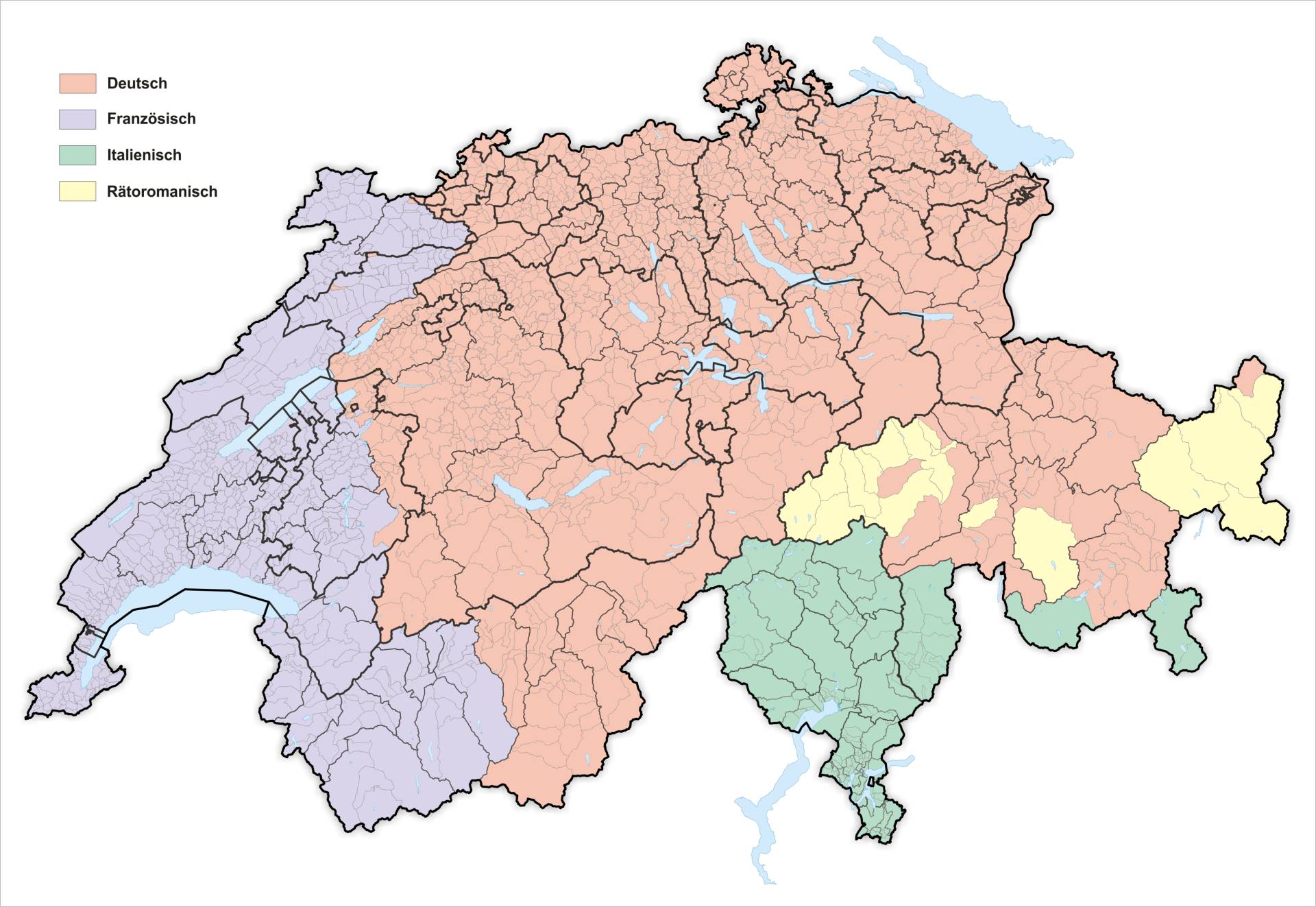
First things first, Switzerland is known for its linguistic diversity.
While the country is one of the smallest in Europe - it finds itself out of the top 30, behind countries like Denmark, Estonia, Iceland and Ireland - it supports four native languages, while English is also widely spoken.
Röstigraben: What is Switzerland’s invisible language and culture barrier?
German - or more specifically Swiss German - is the largest native language in Switzerland, spoken by around 65 percent of the population.
Around 25 percent of the population live in Romandy, the French-speaking west of Switzerland.
Around eight per cent of Swiss speak Italian as their primary language, while approximately one percent speak Romansh.
READ MORE: Everything you need to know about Romansh, Switzerland's fourth official language
...and what about English?
Switzerland prides itself on its multi-lingual nature, which makes it all the more surprising that the country sits so low on the global scale of English speakers.
In a ranking in 2019, Switzerland dropped to 19th in the world for English proficiency, down from 12th in 2017.
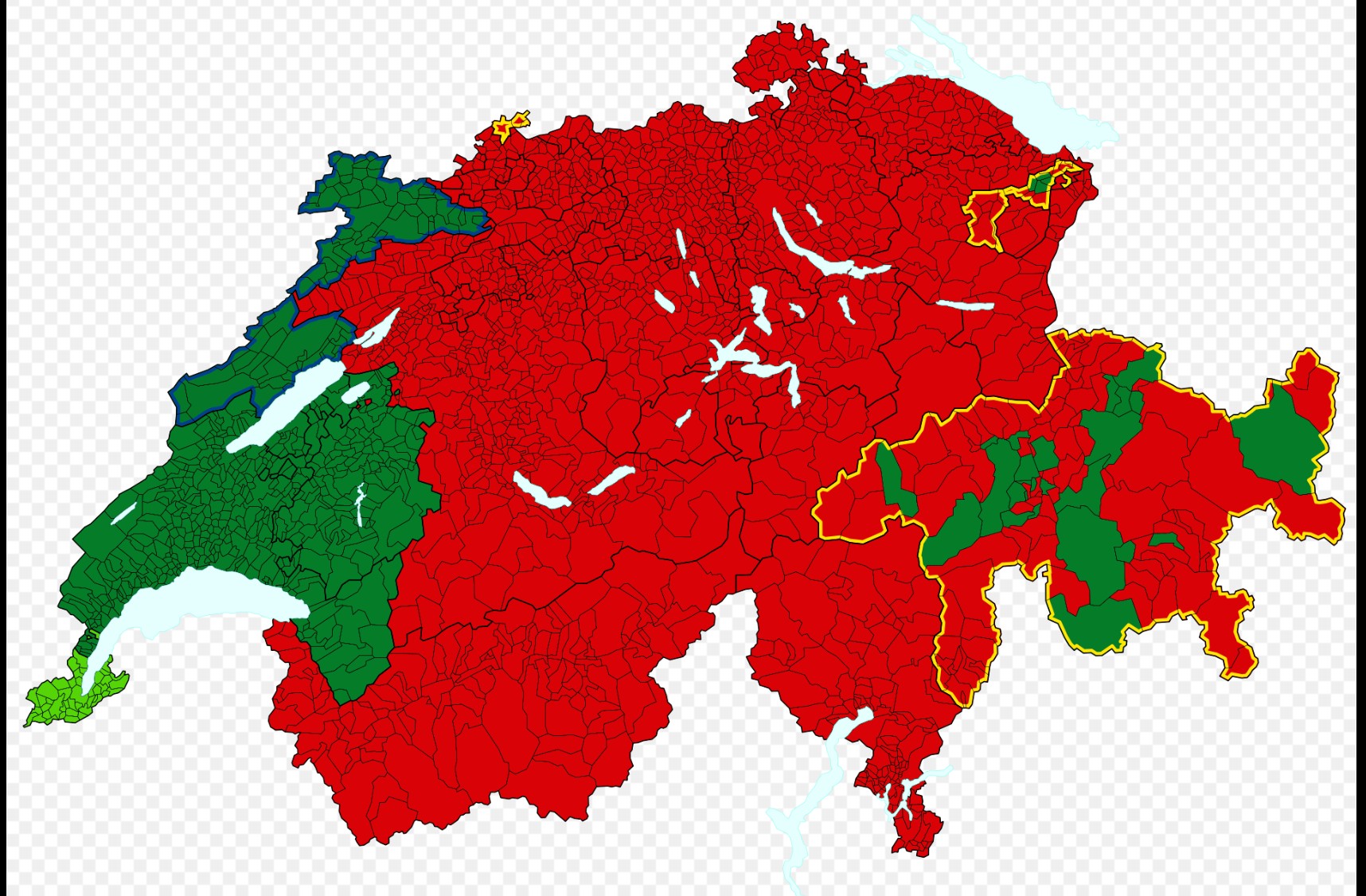
But as the map below shows, the level of English spoken in Switzerland depends very much on where you are.
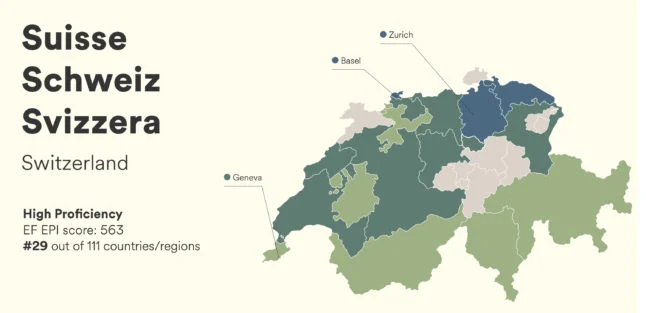
Screenshot: EF English Proficiency Index. Dark blue denotes a "very high" English proficiency level, dark green a "high" level and light green a "moderate" level.
Cantons of Switzerland
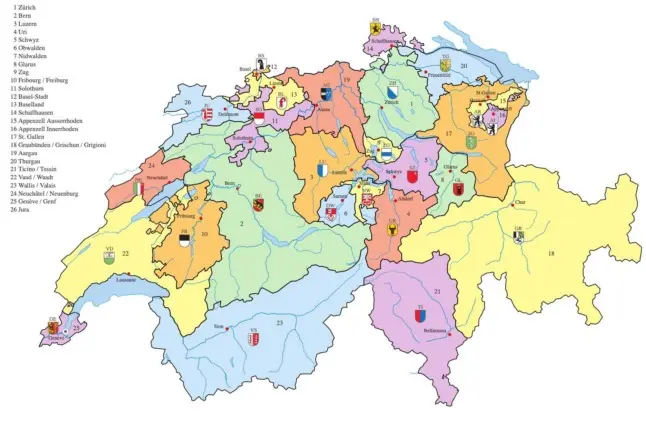
Switzerland is made up of 26 ‘sovereign’ cantons.
Pursuant to the Swiss constitution, federal law does not limit that of the cantons, except in relation to a handful of issues including military, currency, telecommunications and postal services, immigration, criminal law and foreign affairs.
The reaction to the Covid pandemic - where measures differed widely from one canton to another - was a sign of how 'sovereign' Switzerland's cantons consider themselves to be.
The cantons vary widely in population and in area. Zurich is the largest canton with a population of approximately 1.5 million, while Appenzell Innerrhoden is the smallest with a population of just 16,000.
Area wise, the Basel City State is the smallest at 37 square kilometres, while the canton of Graubünden/Grisons is the largest at 7,105 kilometres squared.
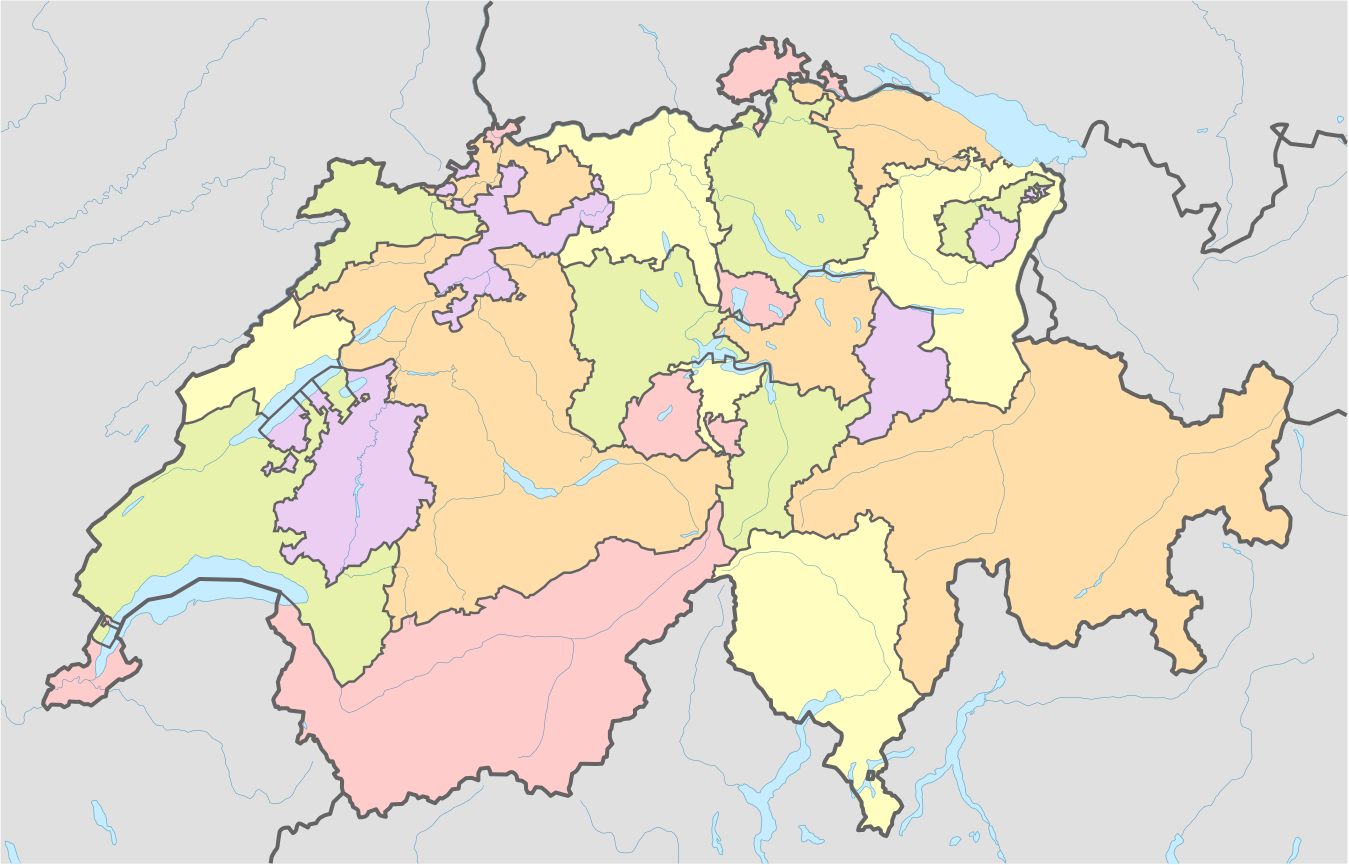
The 26 cantons of Switzerland. Image: Wikicommons
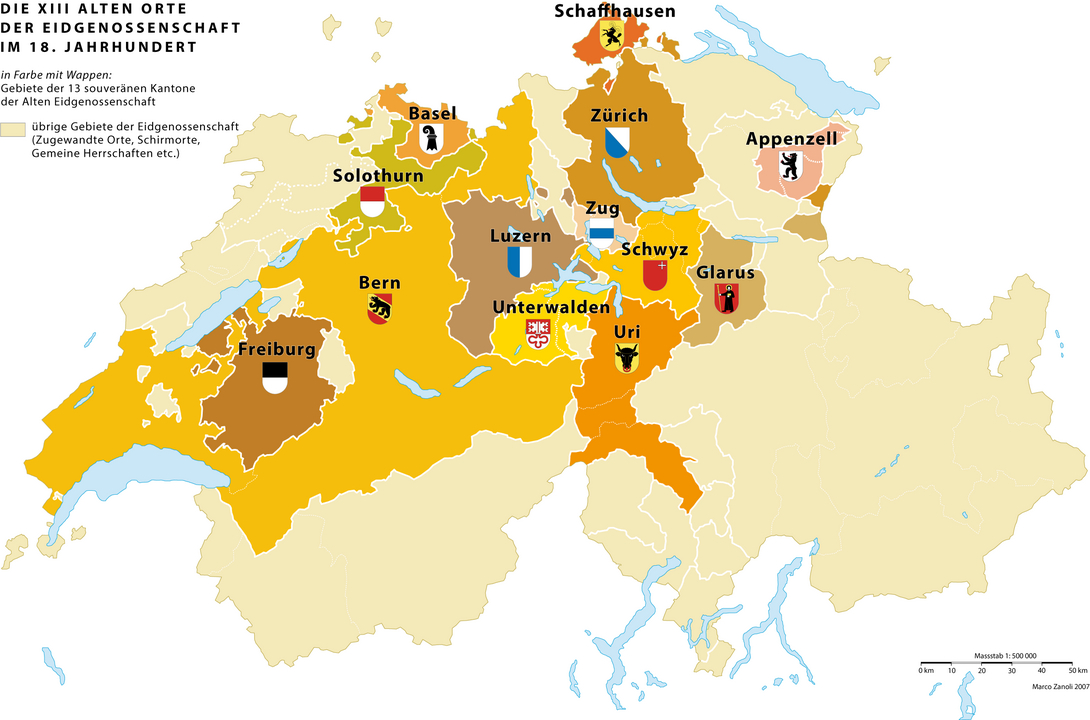
Die Dreizehn Alten Orte (the Thirteen Old Cantons)
In the 16th century, the Original Swiss Confederacy was made up of 13 states, before expanding to 19 and later to 22 in the early 1800s.
Jura was the most recent canton to join the list, splitting from Bern in 1979.
In 2017 the small Swiss town of Moutier indicated a desire to change things up, in a referendum that saw a majority of residents wanting to leave Bern and join neighbouring Jura.
In the same year the Neue Zürcher Zeitung discussed a proposal to reduce the overall number of cantons to 12, while in 2014 state broadcaster SRF considered a proposal reducing the number to nine, but the ideas failed to gain much traction.
The right to vote in Switzerland
According to Federal Statistical Office (FSO), some cantons and communes give their resident foreigners the right to vote on local issues and to elect local politicians.
“By having the right to vote and to be elected, foreigners can play an active but limited role in society,” FSO said.
It added that as Switzerland is a federal state, “there are considerable differences between cantons, and in some cases, between communes. As a result, the opportunities for political participation are strongly dependent on where a person lives.”
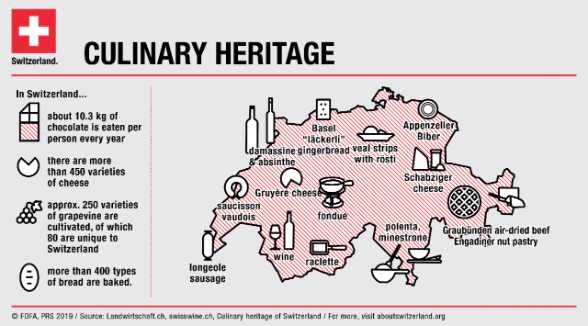
Swiss culinary specialties
Something that might elicit a chuckle out of your average Swiss is the tourist walking into a Swiss delicatessen and asking for a piece of Swiss cheese.
While 'Swiss cheese' might be one of the best known Swiss foods across the globe, Switzerland itself has more than 450 kinds of cheese - only some of which are the traditional emmenthal (and few of which actually have the 'holes' which are commonly thought to be part and parcel of Swiss cheese).
In addition to more than 450 types of cheese, many of Switzerland's regions have their own culinary specialities.
Ridiculous or genius? Meet the British man selling cheese to the Swiss
Some of these are tasty and some are downright weird, but often they'll be ever present in one town, canton or region - and inexistent just a few kilometres away.
The following map, put out by the Swiss government, shows some of the more common specialities.
It also contains some Swiss stats, such as the fact that the Swiss eat more than 10.3 kilograms of chocolate per year.
Purchasing power
Switzerland is a lot of things - but it sure ain't cheap. OK, so it’s a worn out theme, but it still bears repeating.
Although you’re unlikely to find a cheap area of Switzerland to live in, there ARE some areas which are cheaper than others - particularly if you’re employed.
In a 2018 study the place with the highest disposable income was the central canton of Zug, where residents have an average of CHF70,500 per year in disposable income.
READ MORE: Which Swiss canton has the most millionaires?
At the other end of the spectrum, Jura has the lowest disposable income, with an annual figure of CHF36,220.
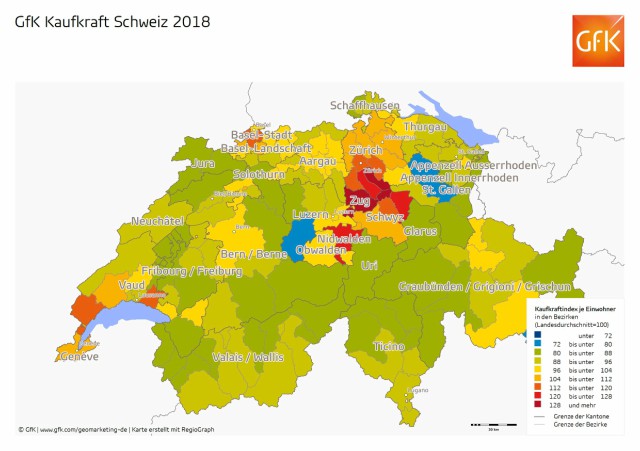
Purchasing power in Switzerland (2018). Image: GFK
Where in Switzerland do all the foreigners live?
Almost one third of adult residents of Switzerland are born outside the country - but where in Switzerland do they all live? We take a closer look.
Figures from the Swiss Federal Statistical Office have provided a breakdown of where foreigners live in Switzerland – and how many there are.
READ MORE: Where in Switzerland do all the international residents live?
Among Swiss residents 15 years of age and over, 30.2 percent are not born in Switzerland – a total of 2,165,000 people out of just over seven million people in Switzerland aged 15 or over. The total population of Switzerland is 8.5 million.
The following map, which contains figures from 2019, provides a geographical indication of where the foreigners live in Switzerland.
As you can see, foreigners can be found all across Switzerland, but there is a particular concentration in the west of the country around Geneva and Vaud, and in the north of the country in Zurich and Aargau.

Religion in Switzerland
Due at least in part to immigration, Switzerland is a diverse country where many religions are celebrated.
However, the country's Christian heritage can still be clearly seen in many ways.
The name one of the country's major political parties - the Christian Democratic Party - has a clear nod to these Christian beginnings, while a look at the most popular names of men and women in the country clearly shows how prevalent Christian names are.
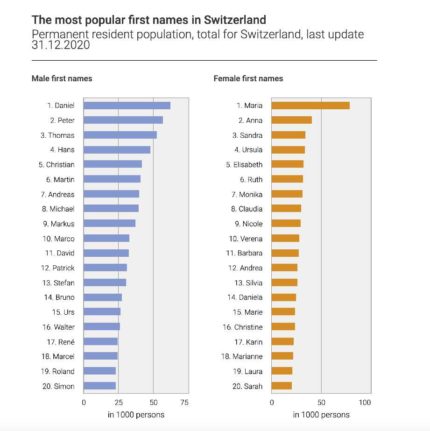
Nationwide maps also show the influence of religion.
Around 36 percent of Swiss identify as Catholic, with a following 24 percent identifying as Protestant.
A further 6 percent were Christians of various denominations, followed by 5.4 percent Muslims and around three percent of other religions.
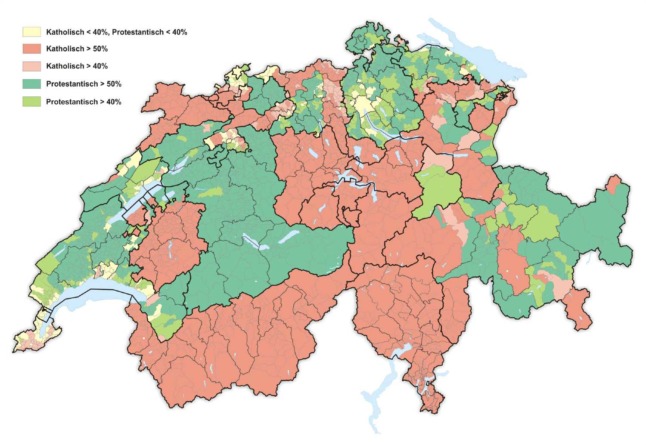
The following map shows which denominations are stronger in which regions. Catholicism is popular in the south and centre of the country, while protestantism is more popular in Romandie, Bern and Zurich.
Comments (1)